

If you’ve been following my work or you’re a student inside my online course, © Naturally Navigating Picky Eating, you may be familiar with my © Complex Picky Eating Paradigm (CPEP) framework, and you may have noticed that the CPEP has been updated. While the core framework remains the same, I wanted to share the “why” behind this visual update, and why it’s such an important part of understanding your child’s complex picky eating.
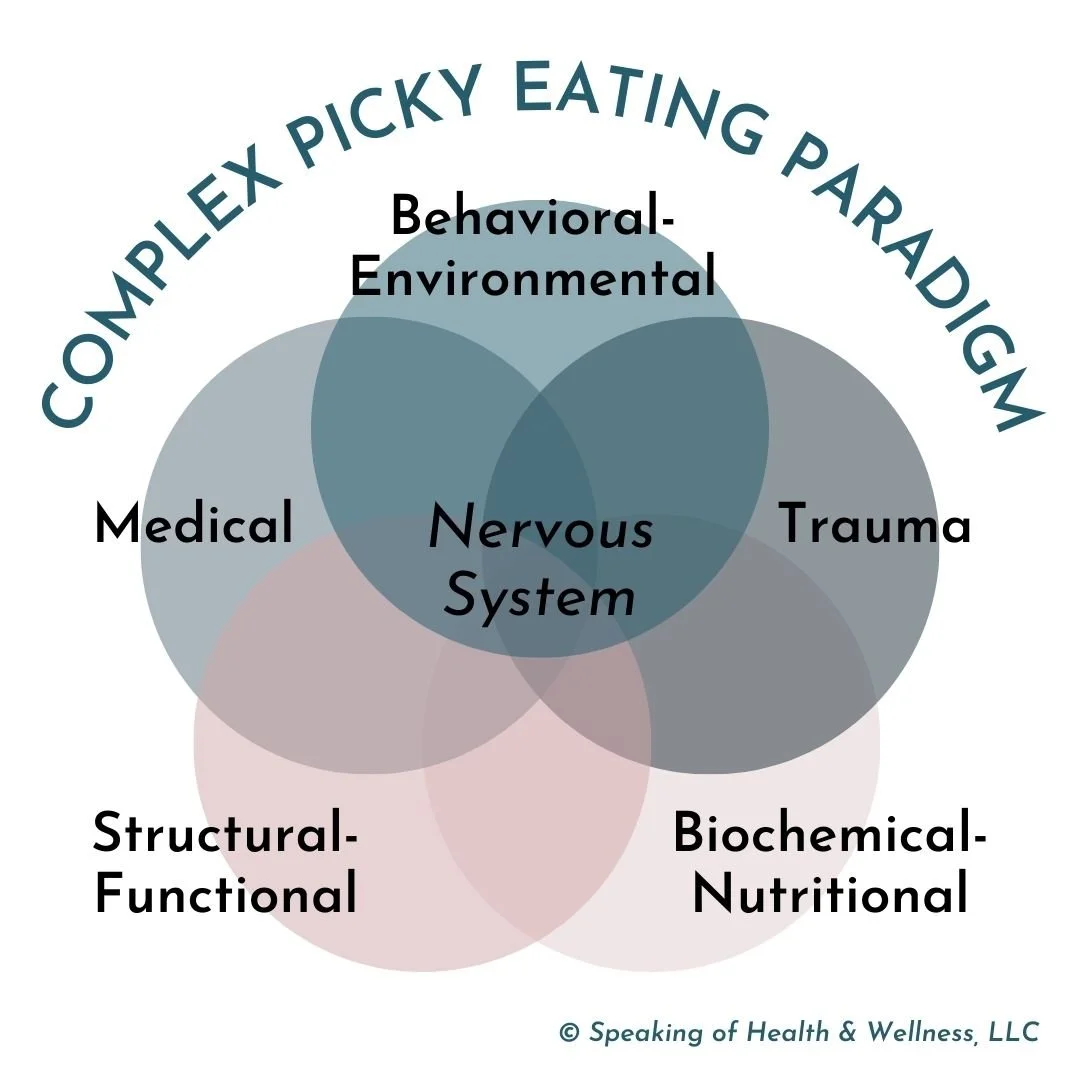
I originally created the CPEP as a framework to help parents understand the root causes of complex picky eating. My goal was (and still is) to show that understanding the why informs the how, using a Venn-style visual where each domain in the framework overlaps with the others, visually representing the multi-faceted, interconnected nature of complex picky eating:
Behavioral-Environmental
Medical
Trauma
Structural-Functional
Biochemical-Nutritional
Over time, as I’ve worked with families, it became increasingly clear that the nervous system plays a central role in how children approach food and mealtimes. That’s why it now occupies the center of the Complex Picky Eating Paradigm, connecting to all of the domains.
The Realization Behind the Update
In the original version, the nervous system was implied within the domains, but it wasn’t visually represented. Through years of working with children and families, I’ve realized: the nervous system isn’t just one factor among many, it is the common thread that influences and is influenced by all of the domains of the CPEP. Further, it’s part of what connects each domain to one another. Representing it visually helps parents see the integral role of the nervous system and the “why” behind their child’s picky eating patterns.
I was recently interviewed for the Experience Miracles™ Podcast hosted by Dr. Tony Ebel, who is a neurologically-focused pediatric chiropractor (Click here to watch the episode on Youtube and/or listen in on iTunes or Spotify). We were geeking out about the nervous system, how it relates to complex picky eating, and I shared about the CPEP. Shortly after recording, I was reflecting on our conversation, and I thought, “What would I have said if he asked me where the nervous system lies within the context of the CPEP?”, and I had a “lightbulb moment”: The nervous system would (should) be represented at the center!
Why the Nervous System Belongs in the Center
Think of the nervous system as the hub in a wheel, or the thread weaving a tapestry. The nervous system has a bidirectional relationship to all of the other domains and it connects all the domains to one another. When a child’s nervous system is regulated and supported, they are physiologically, emotionally, and developmentally more ready to explore new foods.
It’s not about prioritizing one domain over another or emphasizing the nervous system over the five domains. It’s about showing the interconnectedness and helping parents understand why a holistic approach matters.
Examples of How the CPEP Domains Influence the Nervous System
A few examples of many!
Sensory Processing: Over- or under-sensitivity can overwhelm a child, affecting how safe they feel during mealtimes.
Gut Health: Discomfort, bloating, or other digestive distress can trigger stress responses and create strong cravings towards certain foods.
Trauma History: Previous negative experiences around hunger, food, or mealtimes can make a child’s nervous system hyper-alert.
Behavioral: Patterns like rigidity, refusal, or tantrums often reflect physiological responses rather than “willful” defiance. Parental pressure brews a child’s mealtime anxiety, while focussing on “meeting a child where they are” helps to decrease the mealtime anxiety.
Nutrient Status: Deficiencies or imbalances can directly affect mood, energy, and overall nervous system function.
Structural-Functional: Subluxations of the spine can influence the nervous system by interfering with the signals of communication between the brain and the body.
How the Nervous System Influences the CPEP Domains
Conversely, when a child’s nervous system is dysregulated:
Sensory sensitivities may feel more extreme.
Gut issues may worsen.
Exposure to new foods can feel overwhelming.
Behavioral responses at mealtimes (and in general) may intensify.
Learning new skills may be more difficult and slower to progress.
Nutritional interventions may be harder to implement.
Supporting the nervous system, whatever that looks like for your child and family, creates a foundation that makes all other strategies and interventions more effective and more sustainable.
What This Means for Parents
This update is a gentle reminder: meaningful progress isn’t about forcing skills, pushing exposures, or achieving a certain number of bites. It’s about helping your child feel safe, steady, and ready physiologically, emotionally, and developmentally to explore new foods.
Remember: The goal is not obedient consumption of the food. The goal is a healthy, long-standing relationship between the child and their food, mealtimes, their body, and their parents and/or caregivers (as the feeder).
By seeing the nervous system at the center of the Complex Picky Eating Paradigm, parents can better understand why some challenges persist, why certain strategies fail, and why a multi-faceted, compassionate approach works best.
Continuous Evolution
One of the things I love most about working with families is that every child teaches us something new. The updated Complex Picky Eating Paradigm reflects both ongoing research and real world experience from families. It’s my way of evolving the framework to better support these children and families, and make complex concepts more accessible.
The nervous system has always been there… it’s just more visible now! And with visibility comes clarity: when we understand how everything connects, we can help children make meaningful, lasting progress.
If you’re already exploring the Complex Picky Eating Paradigm in my course, you’ll notice this update. For those new here, it’s a helpful lens to understand why complex picky eating is rarely about willpower or “bad behaviors or habits” and why a holistic, nervous-system-informed approach makes a real difference.
Supporting your child’s nervous system is foundational. When their body feels safe and regulated, meaningful progress in feeding becomes possible.
Resources to Learn More About the Nervous System and Picky Eating:
Podcast: S2 | 5. PICKY EATING SERIES: Anxiety, the Nervous System, & Your Child's Complex Picky Eating
Blog: The Missing Piece in Picky Eating: Nervous System Regulation
Want more support as you navigate feeding challenges?
If this updated © Complex Picky Eating Paradigm (CPEP) helped you see your child’s picky eating through a new lens, and you’re wondering how to apply this inside your home, that’s exactly what I walk you through inside my course, Naturally Navigating Picky Eating.
I’m on a mission to create a much needed paradigm shift in how we understand and support children with complex picky eating… and it starts here, with this framework and the step-by-step guidance you can apply at home.
If you’re ready for deeper clarity, support, and a compassionate approach that meets your child where they are, you can learn more about Naturally Navigating Picky Eating here.

Final Encouragement
There’s no quick fix for complex picky eating, but there is a path forward. When you support the nervous system, understand the “why” behind your child’s eating, and build trust at the table, you set them up for a lifelong healthier relationship with food. This is slow, steady work, but it’s transformational.
Wishing your child and family all the very best,
Shandy Watters, M.A., CCC-SLP, FNTP
Speaking of Health & Wellness, LLC