

The two women I love most in this world, my mother and younger (only) sister, both have dyslexia.
With their permission and October being Dyslexia Awareness Month, as we wrap up the month I want to bring awareness to dyslexia by sharing a bit of their experiences and advice.
I polled my instagram audience on what questions they’d want to ask an adult with dyslexia and a mother of a child with dyslexia. The questions were all so good! I narrowed it down to the few that were the most recurring in nature.
My hope is that this reaches a parent of a child who has dyslexia and gives you a variety of perspectives and tips to consider.
A perspective that can only come from the adults living with the same condition. As well as a perspective that only a daughter and sister of someone living with dyslexia can offer. Similarly, keep in my that I'm a speech-language pathologist which also offers another unique angle to my own perspective.
“Dyslexia” falls under the umbrella diagnostic term of Specific Learning Disorder (SLD) which is a classification of a Neurodevelopmental Disorder (NDD). It’s important to note that both learning disorders and cognitive disorders fall under the umbrella of NDDs, but these are different conditions. A child with an SLD will not necessarily have dyslexia, but dyslexia falls within SLD category.
For their privacy, I will refer to them as “My Mom” and “My sister” throughout this blog.
When I pitched the idea of interviewing them both, my Mom was super open to it as I expected. I wasn’t sure how my sister would feel about it. I am grateful for each of their vulnerability and willingness to be open and reflective with me for this collaboration! Additionally, I am grateful that you have taken the time to read more about dyslexia and the two women I love most.

My Mom and sister are both brilliantly bright and passionate women.
As you might expect, the topics and areas they are passionate about are where they excel. They can both rattle off facts on facts for days about what they love and what genuinely lights them up!
For both of them, especially my sister, it’s horses. Horses have been their bond over the years and they both have this indescribable fearless grace, a “horse sense” that blows my mind.
My Mom can identify all sorts of trees, plants, dogs, horses, and wild animals. She can shout out the year of old car models when she sees them. Both of their intelligences are “normal” but their reading and writing are challenging. For example: I will be calling her to read this blog post to her once published and she’ll read along (or not) while I read it outloud.
My Mom doesn't like to read or write in long lengths because it’s a struggle for her, but she’s learned how to compensate for the areas she needs help with in her life. Shout out to my Dad for being the prominent person to help when and where she needs support. (He deserves recognition here too for his support of course!) My Mom’s dyslexia is more severe than my sister’s.
My sister is a poetic and gifted writer, a talented artist, guitar player, and all around made of pure magic. Every year I watch her step more into herself and grow into a young woman is a privilege. I have tears in my eyes writing it. She’s still learning her full greatness each day but my parents and I have always felt it.
I think you get the point here - I want you to know that dyslexia is just one piece of who they are. It is not who they are. I am intentionally using “first person language” (ex: “person with dyslexia” vs. “dyslexic person”) for those very reasons.

They happen to have dyslexia but they are not their diagnoses.
Please remember this when thinking of your children (and how you and others speak about them in front of them).
It is my honor to share their experiences to shed light on living with dyslexia.
Without further ado, let’s dive into my brief interview with each of them…
I texted my Mom a few questions to think about and told her she could text me back or we could talk about it. The process of typing her replies is too tedious and cumbersome, so she preferred to have me call her.
We spoke for about an hour and she told me stories that I hadn’t heard before. Including one where she was bullied and humiliated as an adult (like middle school style bullying) at a job for her spelling errors in front of the team. I was furious and hurt for her. I can’t imagine the audacity of these other adults...or how that must have made my Mom feel as a grown woman who thought she was done being bullied for learning differently.
She also enlightened me on some of her self talk and affirmations that she’s had on mental repeat and grown into over time. Below are her answers and takeaway messages paraphrased from our conversation.
What are the top tips you would tell a parent of a child who has dyslexia?
“Be patient and understand that your child learns differently”
“Find their strengths and maximize what they love when they’re struggling to learn”
“Recognize when they need breaks and what resets them”
“Be their voice and watch closely for overwhelm in the school system”
We talked about how children’s work loads in schools are already so overloaded. School looks very different than when we were children. When you add a learning disorder on top of that, it can turn overwhelming fast. Especially the transition from elementary to middle school, when academic demands increase.
My Mom emphasized being aware of the various ways that you can advocate for your child within the school even though you’re not there, including by putting IEP accommodations and supports in place. An “IEP” is an Individualized Education Plan that is a legally binding document that a child qualifies for through a Special Education evaluation. Goals and accommodations are discussed based on the child’s needs and grade requirements. This plan is meant to serve as the roadmap to helping the child receive access to fair and appropriate public education, their right by federal law (if qualified).
As a clinician, I always want to empower parents to know and understand that they are just as important of a role as each of the professionals around the table of the IEP meetings. If your child has difficulty with phonology, reading, spelling, writing, etc., that’s all impacting their access to academics! You are able to add in your own ideas and thoughts into the language of the IEP. In fact, you should! They are the experts in their fields but YOU are the expert on your child! It’s up to you to advocate for them and teach them how to be the best advocate for themselves.
You are not required to sign an IEP until you agree with the document. If needed, find an advocate to support you with the school system. Thankfully in my sister’s case, this was never required and the school was always pretty supportive (although, didn’t always fully have the resources which is unfortunately common).
If you could describe your experience while reading and learning, how would you best describe it?
When I asked her this, my Mom sighed a big breath and said,
“Reading...I don’t like to do because I struggle. For me to grasp it, I have to read it over and over and over and over again. People take reading for granted”.
When she said that it hit me deeply. I realized in that moment that I, as her daughter, do in fact take reading for granted too often.
She shared how even jobs that many would consider “simple” would be very difficult for her. Being a waitress, bank teller, cashier, gas station attendant, etc. Anything with reading letters and numbers is challenging, especially in a situation where there would be a time pressure.

My Mom is a trained and experienced dog groomer. We live in a rural area where these jobs aren’t plentiful. When I was growing up, my Mom stayed home and cared for us when we were very young, which I am so thankful for! When my younger sister entered school, my Mom worked as a dog groomer and held other various jobs throughout the years. My Mom learned to maximize her strengths throughout her life for the jobs she’s held. She’s very in tune with animals and is an incredibly patient woman, and a selfless caregiver. She has held roles caring for animals and people in varying capacities.
We discussed the idea of dyslexia being popularly simplified as “reading backwards”. Like my sister has also described to me: It’s not that they’re reading backwards, it’s that the letters and numbers “jump and scramble”. For example, my Mom almost always writes “talk” as “tlak”.
As a speech-language pathologist, I can’t help but be able to reflect on the language and phonological components of how she is receiving and expressing written language. I can only have sincere empathy for her experience, as I imagine it would be frustrating to experience throughout your life. I know it has been for her and I’m inspired by the way she doesn’t allow it to limit her in any way.
She took me to the library a lot as a child. During our call, she told me she always felt I was “in tune” with her. As I became a better reader than her growing up, she realized I was in tune with where/when she needed help with various tasks requiring reading and writing.
What strategies and strengths do you use in your daily life for your success? (Direct Quotes)
“I’ve learned not to be afraid to ask for help when I need it. I try not to make excuses for myself and recognize when I am.”
“I’ve realized I need to slow myself down and remove myself from situations when possible then re-entering before reacting. Sometimes I need to shut my brain off for a second and let it catch up with itself”
“I make lists and write things down a lot.”
My Mom leaves herself notes to remind her to do things and help her remember what order to execute tasks. I do this as well, personally.
She described herself as a very hands-on learner and noted preferring being read to vs. reading herself when learning and testing.
Words of wisdom to others who have dyslexia and/or other learning disorders:
“Don’t beat yourself up and don’t let society tell you that you can’t learn”
“Don’t ever be ashamed of who you are”
“Know you’re different but that’s what makes you you” (the collection of everything about you - not just your learning difference).
“The biggest thing is accepting that you have limitations. I continue to work on this through out my life. Some days it frustrates me so bad. I don’t know if it’s the ADHD or the dyslexia, but sometimes my brain feels like it’s going faster than the body can handle.”
Without going into detail, I also want to note from an epigenetic perspective that my Mom’s childhood was not “all sunshine and roses”. She grew up in a home with limited resources and not the best nutrition for the beginning of her life. Additionally, she experienced events that would make anyone “grow up” faster than a kid is supposed to.
Knowing what I know professionally, while also being her daughter and knowing all she’s been through, I can’t even begin to articulate how infinitely proud and inspired I am to be her daughter. She’s faced hurdles every day that we can’t really grasp because we don’t live with dyslexia.
Can you imagine triple or quadruple checking everything that you read and wrote?Can you imagine always being self conscious and unable to trust yourself that you’ve read it and/or written it correctly?
My Mom is my best friend and my absolute idol. We have always been incredibly close. I’m blessed to say my family unit as a whole is very strong! We’re all very close despite living in separate parts of the country. My Mom has been a phenomenal guide and role model for my younger sister, who also has dyslexia.
During the call with my Mom she said, “I’m so glad your sister doesn’t have it as severe as I do”. There are so many variables to the spectrum of neurodevelopmental disorders and in this case, consider a spectrum of dyslexia. Imagine the ways my Mom must’ve supported her from a place of true understanding because she knew what it was like first hand.
I have this image of my little sister doing her homework at the kitchen table, slamming her pencil down as she bounced up in her chair with a frustration sound…
If I could time travel back, I would hug her and whisper, “Don’t worry - Everything will be okay. Guess what - you’re going to grow up and work with horses like you’ll always dream of, live somewhere warm all year round, and you’ll be the most amazing woman!”
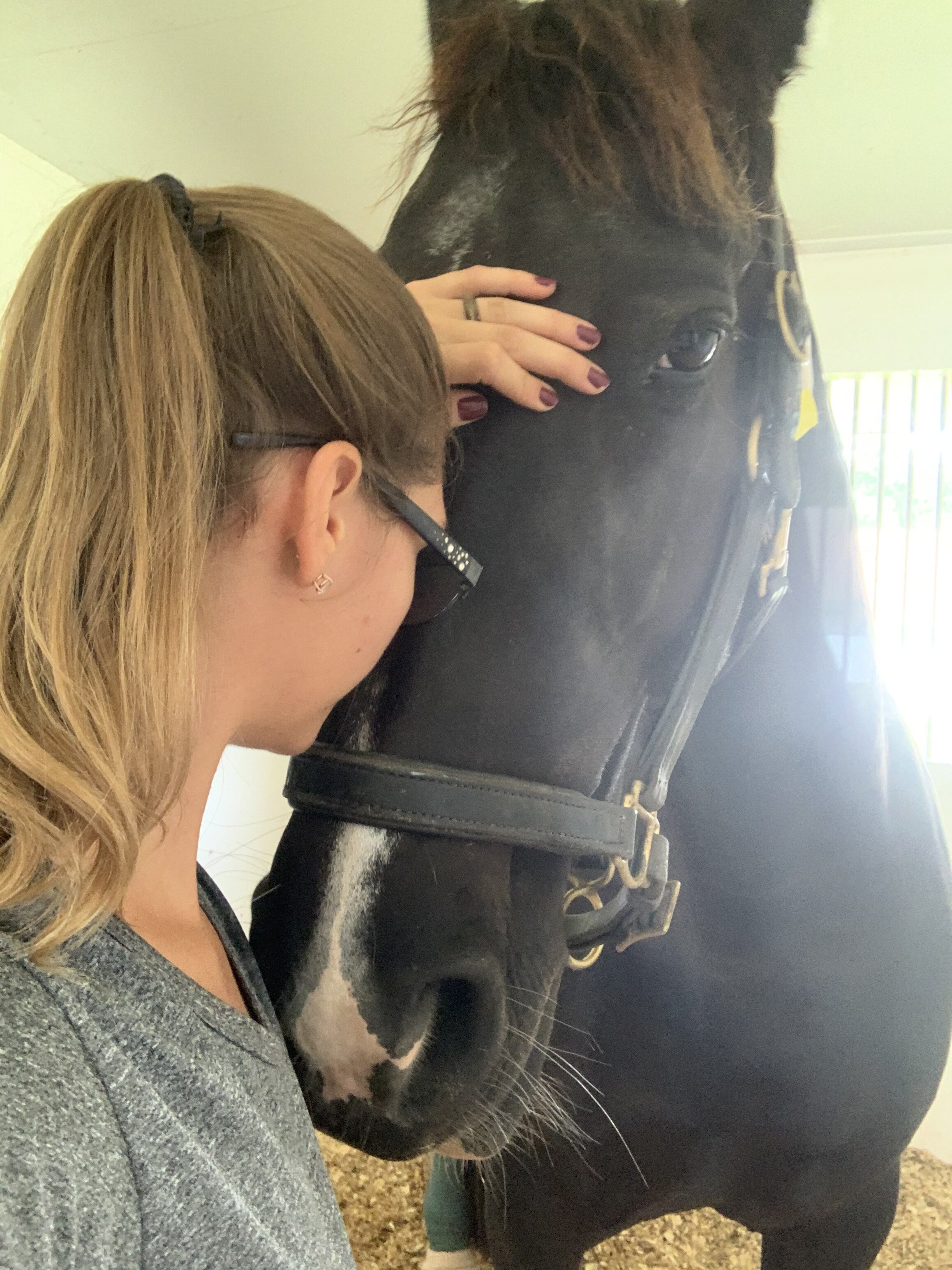
I received my sister’s responses by text and she has given me permission to share her text unedited verbatim. Please keep in mind: She didn’t know that I was going to share in this way, so she may have further edited if she knew that.
We both thought it was appropriate to share her unedited, uncorrected, and natural response in honor of this being a Dyslexia Awareness post.
What are the top tips you would tell a parent of a child who has dyslexia?
“I’d tell the parents that patients is important, they can’t always trust to sound out a word or follow that math equation correctly because eyes lie to them so often.
Also being involved with your child’s school work at home, but also at school.
Sometimes kids don’t know how to be their own advocate and need that extra help. It’s important that the teacher work on different strategies in the classroom because your child may find it hard to follow.”
If you could describe your experience while reading and learning, how would you best describe it?
“The easiest way to describe my reading and learning experience is that I personally do much better with things hands on.
It’s hard to remember orders In which steps to follow.
When I was younger it was complicated and hard to trust anything I put down on paper. In fear that no other person could read and comprehend my work.”
Words of wisdom to others who have dyslexia and/or other learning disorders:
“Over the years I struggled with reading, learning a second language and math. It wasn’t until I got older and learned my own disability and how it worked for me.. to be able to cope with the every day struggle.
You’ve got to stop disliking yourself for being the way it is. Once I excepted that I was dyslexic, i was easier on myself.. though the biggest thing I can’t stress enough is patience.. with your children ^^ and with yourself.
Hope this makes sense and that it is useful. Let me know if you have questions.. Love you Shandy”
When I read her replies it was a couple hours after having the phone conversation with my Mom. There is so much overlap between what my Mom said and her responses. Especially the emphasis of holding patience for yourself and your child, and accepting it vs. making it something negative about yourself.
My eyes welled with tears as I read her answers and thought about how proud and fulfilled our incredible Mother should be for raising such a resilient and radiant soul! My parents and I are so intensely proud of my sister.
My Mom, who happens to have dyslexia, has been happily married to her high school sweetheart and love of her life for over 30 years. They’ve raised two successful children and are doing great!
My sister, who happens to have dyslexia, has a job she loves working with horses and is thriving in the young prime of her beautiful life!
If your child happens to have dyslexia as well (or other learning disorder), I know that you’ve gained inspiration in some way from this blog post.
On the next tough day your little one has, I hope that you will remember this blog post about two women I love most in this world - my mother and younger sister, who happen to have dyslexia.
A gentle reminder from my family to yours:
Be patient with your child and with yourself.
(Couldn’t have said it better Mom and sister! xo)
To my Mom and sister - Thank you for letting me share our interviews and your words here on my site for others to learn. Thank you both for walking this life as your authentic selves and inspiring me to do the same. I’m honored to learn from and share your experience. I’m blessed and grateful for you both! (and Dad! And “the critters!”)


